
6.4 KiB
Mixbox for Dart/Flutter
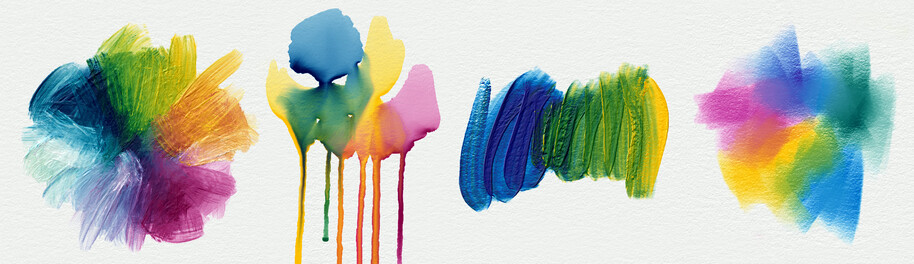
Dart implementation of Mixbox 2.0 - physically realistic color mixing simulating real pigment behavior.
🎨 Why Mixbox?
Classic RGB mixing produces dull colors:
- Yellow + Blue = Gray ❌ (in RGB)
- Yellow + Blue = Green ✅ (with Mixbox)
Mixbox simulates physical pigment behavior for natural results.
📦 Installation
1. Add the files
lib/
  mixbox/
    mixbox.dart
    mixbox_loader.dart
assets/
  mixbox_lut.dat
2. Dependencies in pubspec.yaml
dependencies:
  flutter:
    sdk: flutter
  archive: ^3.4.0

flutter:
  assets:
    - assets/mixbox_lut.dat
3. Download the LUT
The mixbox_lut.dat file must be downloaded from:
- Official source: https://github.com/scrtwpns/mixbox
- Place it in
assets/mixbox_lut.dat
⚠️ Important: Without the LUT, Mixbox won't work properly.
🚀 Usage
Initialization (once at startup)
import 'mixbox_loader.dart';

void main() async {
  WidgetsFlutterBinding.ensureInitialized();

  // Load the LUT
  await MixboxLoader.initializeFromAsset('assets/mixbox_lut.dat');

  runApp(MyApp());
}
Simple mixing (2 colors)
import 'package:flutter/material.dart';
import 'mixbox.dart';
import 'mixbox_loader.dart';

// Extension for easy use with Flutter Color
final yellow = Color(0xFFFEEC00);
final blue = Color(0xFF190059);

final green = yellow.mixWith(blue, 0.5); // 50% of each
Multi-color mixing (3+)
final red = Color(0xFFFF2702);
final yellow = Color(0xFFFCD300);
final blue = Color(0xFF0D1B44);

// Convert to latent space
final z1 = Mixbox.rgbToLatent(red.toMixboxInt());
final z2 = Mixbox.rgbToLatent(yellow.toMixboxInt());
final z3 = Mixbox.rgbToLatent(blue.toMixboxInt());

// Custom mixing
final zMix = List.generate(
  Mixbox.latentSize,
  (i) => 0.4 * z1[i] + 0.3 * z2[i] + 0.3 * z3[i],
);

final mixed = Color(Mixbox.latentToRgb(zMix));
Physically correct gradient
final gradient = List.generate(
  10,
  (i) => yellow.mixWith(blue, i / 9.0),
);
🎨 Predefined Pigment Colors
Use these colors for realistic results:
const cadmiumYellow = Color(0xFFFEEC00);       // Cadmium yellow
const hansaYellow = Color(0xFFFCD300);         // Hansa yellow
const cadmiumOrange = Color(0xFFFF6900);       // Cadmium orange
const cadmiumRed = Color(0xFFFF2702);          // Cadmium red
const quinacridoneMagenta = Color(0xFF80022E); // Quinacridone magenta
const cobaltViolet = Color(0xFF4E0042);        // Cobalt violet
const ultramarineBlue = Color(0xFF190059);     // Ultramarine blue
const cobaltBlue = Color(0xFF002185);          // Cobalt blue
const phthaloBlue = Color(0xFF0D1B44);         // Phthalo blue
const phthaloGreen = Color(0xFF003C32);        // Phthalo green
const permanentGreen = Color(0xFF076D16);      // Permanent green
const sapGreen = Color(0xFF6B9404);            // Sap green
const burntSienna = Color(0xFF7B4800);         // Burnt sienna
📊 Complete API
Main methods
// Mix int (0xAARRGGBB)
int Mixbox.lerp(int color1, int color2, double t)

// Mix list [r, g, b] or [r, g, b, a] (0-255)
List<int> Mixbox.lerpList(List<int> color1, List<int> color2, double t)

// Mix float [r, g, b] or [r, g, b, a] (0.0-1.0)
List<double> Mixbox.lerpFloat(List<double> color1, List<double> color2, double t)

// Mix linear RGB (for 3D rendering)
List<double> Mixbox.lerpLinearFloat(List<double> color1, List<double> color2, double t)
Conversions
// RGB → Latent
List<double> Mixbox.rgbToLatent(int color)
List<double> Mixbox.floatRgbToLatent(double r, double g, double b)

// Latent → RGB
int Mixbox.latentToRgb(List<double> latent)
List<double> Mixbox.latentToFloatRgb(List<double> latent)
🧪 Complete Example
import 'package:flutter/material.dart';
import 'mixbox.dart';
import 'mixbox_loader.dart';

void main() async {
  WidgetsFlutterBinding.ensureInitialized();
  await MixboxLoader.initializeFromAsset('assets/mixbox_lut.dat');
  runApp(const MyApp());
}

class MyApp extends StatefulWidget {
  const MyApp({super.key});

  @override
  State<MyApp> createState() => _MyAppState();
}

class _MyAppState extends State<MyApp> {
  double _mix = 0.5;

  final _yellow = const Color(0xFFFEEC00);
  final _blue = const Color(0xFF190059);

  @override
  Widget build(BuildContext context) {
    final mixed = _yellow.mixWith(_blue, _mix);

    return MaterialApp(
      home: Scaffold(
        appBar: AppBar(title: const Text('Mixbox Demo')),
        body: Column(
          children: [
            Container(height: 200, color: mixed),
            Slider(
              value: _mix,
              onChanged: (v) => setState(() => _mix = v),
            ),
          ],
        ),
      ),
    );
  }
}
⚙️ Advanced Configuration
Without the LUT (Testing only)
// Generates an approximation (NOT recommended in production)
final testLut = MixboxLoader.generateTestLut();
Mixbox.initialize(testLut);
Linear Space (3D Rendering)
For shaders/3D rendering, use linear space:
final color1Linear = [1.0, 0.5, 0.0]; // Linear RGB
final color2Linear = [0.0, 0.2, 1.0];

final mixed = Mixbox.lerpLinearFloat(color1Linear, color2Linear, 0.5);
📝 License
Creative Commons Attribution-NonCommercial 4.0
- ✅ Free non-commercial use
- ❌ Commercial use requires license
- Contact: mixbox@scrtwpns.com
🔗 Resources
- Official website: https://scrtwpns.com/mixbox
- Paper: https://scrtwpns.com/mixbox.pdf
- GitHub: https://github.com/scrtwpns/mixbox
- Interactive demo: https://scrtwpns.com/mixbox/painter/
❓ FAQ
Q: Why is the LUT necessary?
A: It contains pre-calculated data from the physical pigment model (64×64×64 = 262,144 values).
Q: Can I use it without the LUT?
A: No for correct results. The generateTestLut() function is just for quick testing.
Q: Performance?
A: Very fast (~1μs per mix). Trilinear interpolation is optimized.
Q: Difference with HSV/HSL?
A: HSV/HSL are mathematical transformations. Mixbox simulates real pigment physics.
Q: Does it work for animation?
A: Yes! Perfect for gradients, transitions, and smooth animations.
🎯 Use Cases
- 🎨 Drawing/painting applications
- 🌈 Natural gradients
- 🎬 Content creation tools
- 🎮 Game color systems
- 🖼️ Realistic photo filters
- 📊 Data visualizations